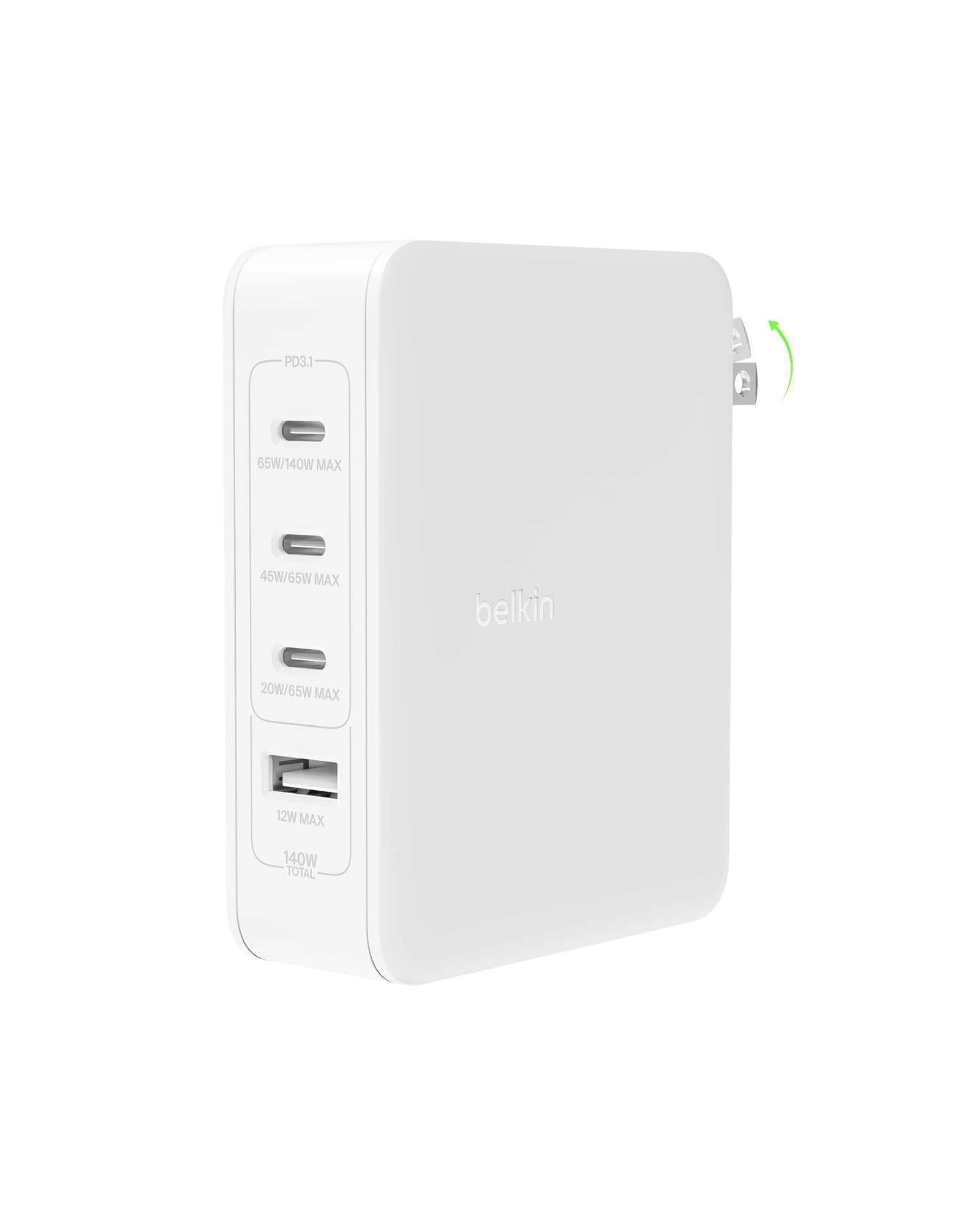
The BoostCharge Pro 140W is the honest workhorse of the 140W class: it feeds a 16-inch MacBook Pro at full tilt, runs two laptops at 65W each, and published load tests back its ratings. The tax is physical — 341-plus grams, no cable in the box, and allocation rules you have to memorize.
— THE VERDICT · JUDGEANY EDITORSWhat it is
Belkin's BoostCharge Pro 140W (model WCH014, on sale since August 2023) delivers 140W through a single USB-C port. It fits three USB-C PD 3.1 ports and one 12W USB-A into a 75.2 × 30.8 × 95 mm brick weighing 341–360 g — more than an iPad Mini. GaN keeps it smaller than a silicon equivalent would be, but it is still a big brick. The US version gets foldable prongs; other regions get interchangeable plug tips, and some markets add a drawstring pouch. No cable in the box.
Port power and allocation
The top USB-C port is the headline: up to 140W via PD 3.1 EPR (28V/5A), with PPS up to 100W. The other two USB-C ports top out at 65W each, and the USB-A port gives a fixed 12W. The sharing logic has sharp edges worth memorizing: a second USB-C device drops the top two ports to 65W each, touching the USB-A port alongside the top USB-C cuts that port to 100W, and all four ports loaded splits 65/45/20/12W across the three USB-C ports and the USB-A. Belkin documents the single-port maximums plainly; the combined behavior rewards a look at the chart before you pack.
Measured performance
Published measurements back the ratings. ShaunChng's bench tests pulled 96.3W combined across four loaded ports from 115.2W at the wall — about 83.6% efficiency — with no dropouts. Trevor Tan recorded 96W into a 14-inch M2 MacBook Pro, took a 16-inch model from 80% to full in 10 minutes on the top port, and a 14-inch from 8% to 61% in half an hour. Digital Reviews confirmed the combination that matters: two ultrabooks drawing 65W each at the same time, a phone topping up beside them. Can Buy or Not hit the same 96W ceiling on its 14-inch M2 MacBook Pro, noting it had no 16-inch machine to push the 140W port to its limit — the full 140W single-device draw is still unmeasured in the published record, which says more about reviewers' test benches than the charger.
Thermals and efficiency
Here the published evidence disagrees. Digital Camera World's Gareth Bevan ran two MacBooks and a Pixel 8 Pro at once and reported the brick stayed cool — only warm to the touch even when pushed. ShaunChng's bench tells a warmer story: 55.9°C at the surface under a sustained four-port stress test, with a caution that prolonged high-load charging may shorten the charger's life. The two aren't mutually exclusive — real devices taper their draw as batteries fill, while a bench rig holds the load flat. Put together: this charger runs warm to genuinely hot at full tilt, exactly what 140W in this footprint should do, and 83.6% port-to-wall efficiency is respectable without being remarkable.
Living with it
The size is the recurring complaint. At 341–360 g the brick can sag in loose wall sockets — The Brag had it pull away from the outlet mid-charge during testing. Alex Reviews Tech scored it 3.5/5: four-port flexibility and travel adapters on the plus side, bulk, price, and a missing cable on the other. Set against that: a two-year warranty plus a $2,500 connected-equipment warranty, recycled-plastic construction, and plug adapters that make it a genuine one-brick travel kit. On reliability, Czech outlet Letem svetem Applem ran all four ports loaded for an extended stretch with no dropouts, no heat complaints, and no coil whine. The remaining gaps: no MFi or USB-IF certification, and indoor use only.
Who it's for
This charger earns its keep in the two-laptop household or the one-bag travel kit — one brick that feeds a 16-inch MacBook Pro and still has room for a second laptop, a tablet, and a phone. If you charge one device at a time, it is overkill in every dimension: size, weight, and money, and a 65W single-port GaN brick would serve you better. Check the current price on Amazon before deciding — the value case moves with the street price.