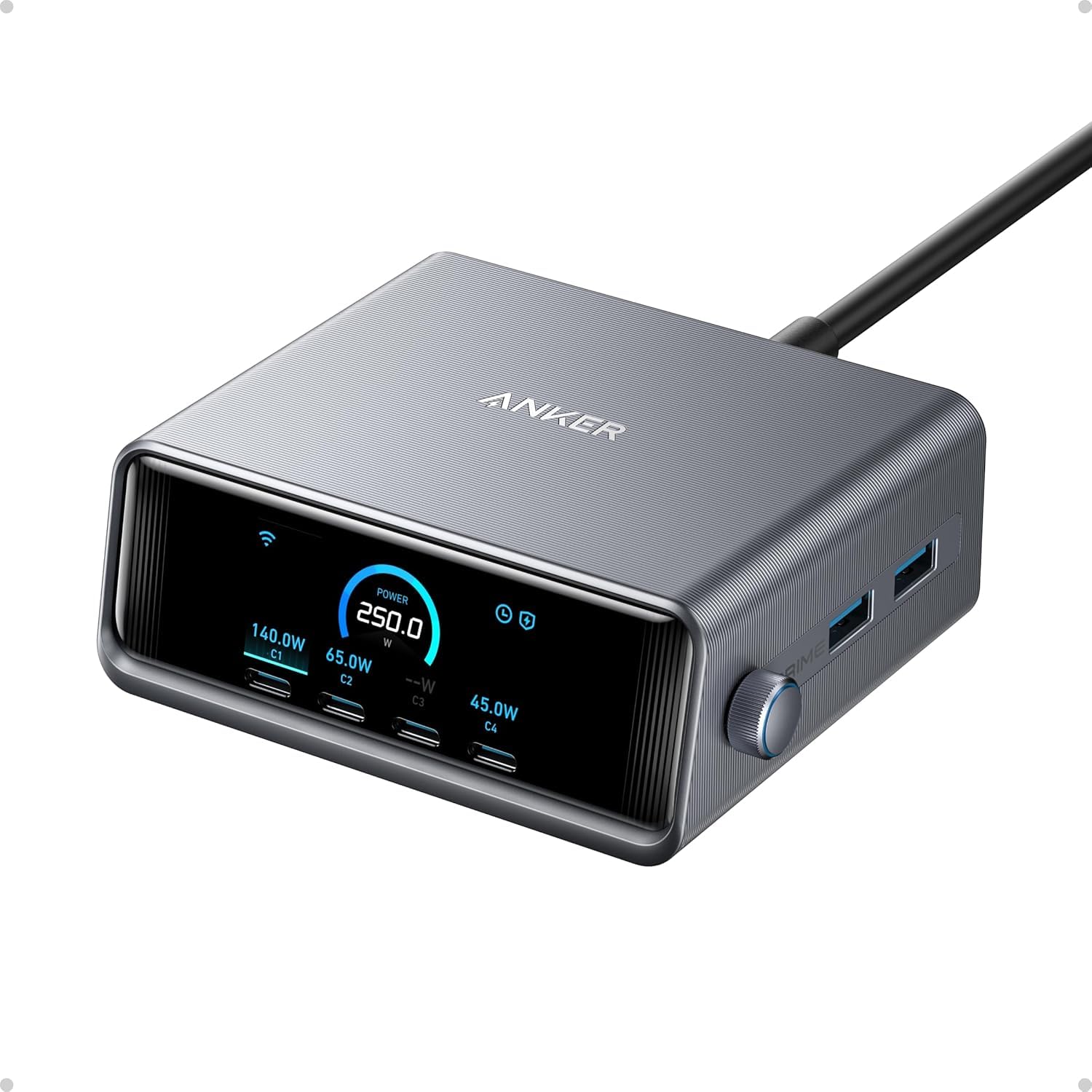
The Anker Prime 250W delivers its spec sheet: 140W from USB-C1 over PD 3.1, 250W shared across six ports, readouts on a 2.26-inch display. It runs warm, not hot, and the port-split rules are honest. The pushback is about need — most desks don't need this much charger, and app layer adds little. For a laptop-plus-fleet desk, it's the answer.
— THE VERDICT · JUDGEANY EDITORSWhat the Prime 250W is
This is Anker's flagship desktop charging station (model A2345): 250W of total output split across four USB-C ports and two USB-A ports in a GaNPrime brick that weighs 640 g and sits on your desk, not in your pocket. The headline spec is the first USB-C port — 140W over PD 3.1 (28V/5A), which puts it in the small club of chargers that can fast-charge a 16-inch MacBook Pro at full speed. The other three USB-C ports each cap at 100W, the USB-A pair at 22.5W. A 2.26-inch LCD shows real-time per-port wattage, and a physical dial next to the ports cycles through power modes.
The port-split rules that actually matter
One device on USB-C1 gets the full 140W. Two ports in use cap at 240W combined (140W + 100W); with three to six ports in use the total rises to 250W. Digital Camera World documented a full six-port split of 70W + 70W + 45W + 30W + 15W + 15W. The instruction manual adds that custom charging profiles let you set each port's power with a slider — an owner on Amazon.ae ran a 100-70-80 configuration across three USB-C ports for three laptops while disabling the rest. The 250W is real shared power, not a per-port number — put your hungriest device on C1.
What published tests found
Macworld's hands-on review calls the station compact for what it is — 4.18 x 1.58 x 3.64 inches — and notes C1's 140W fast-charges a 16-inch MacBook Pro to 50% in about 25 minutes with Apple's MagSafe 3 cable. Anker's own listing makes the same 25-minute claim. On the lab side, a YouTube bench-testing channel put the A2345 through protocol compatibility checks (PD 3.1 140W EPR, PPS, QC, UFCS, SCP/FCP), voltage-ripple measurement, and a sustained 240W thermal stress test to map its throttling limits — the kind of abuse testing no marketing page survives unchallenged. We run no lab; scores below are editorial judgments on this published evidence.
Where reviewers push back — and why the verdict still holds
The dissent is real: Android Police calls the Prime 250W 'overkill in every way,' scores it 6.5/10, and flatly tells readers to buy the cheaper 200W sibling instead. Can Buy or Not finds the Wi-Fi app connectivity 'honestly kinda pointless' and left the charger in AI Power Mode forever after trying the modes once. And an owner on Amazon.ae caught the built-in power meter lying: the display showed 75W + 75W across two cables while external meters confirmed the real split was 110W + 40W — treat the per-port numbers as approximate, even if the combined figure was spot on. Yet none of the critics dispute the core: it delivers its claimed wattage, it runs warm rather than hot under load (BikmanTech's Q&A and the owner review agree), and the charging modes genuinely work. The disagreement is about whether you need all of this — not whether it works. For a multi-laptop, multi-device desk that funnels everything through one outlet, it does.
Who should buy it
If your desk regularly powers one or two laptops plus a fleet of phones, earbuds, a watch, or a handheld console — and you want to replace a nest of wall bricks with a single station that tells you what each port is doing — check it live on Amazon. Skip it if you only charge a phone and earbuds, if you travel with your charger (this is 640 g of desk furniture), or if you expect the smart features to earn their keep — reviewers mostly left them on auto.